
By Elvis Sipe
Selling Before FLIBS 2026: Why September Is the Deadline That Matters
The Fort Lauderdale International Boat Show opens October 28, 2026. If you are thinking about selling, the work that determines your outcome happens in the seven weeks before the gates open — not during show week.
Should you list your boat before the Fort Lauderdale International Boat Show? If you want to sell in this cycle, yes. FLIBS 2026 runs October 28 – November 1 and pulls qualified buyers into South Florida for the entire winter season. A boat listed in September is photographed, priced and syndicated before they arrive. A boat listed during show week is not.
Key takeaways
- The 67th Fort Lauderdale International Boat Show runs October 28 – November 1, 2026, across nearly 90 acres and seven waterfront venues.
- The 2025 edition drew more than 100,000 attendees, 1,000 exhibitors and 1,300+ vessels; 2026 is expected to display roughly $4 billion in yachts and marine product.
- Per Northrop & Johnson's market data, pre-owned yacht sales fell 8% year-over-year to 326 transactions while aggregate sales value rose 15% to $3.51 billion — fewer buyers, bigger commitments.
- Preparing a listing properly — media, records, comps, syndication — takes weeks, not days. From early September, FLIBS is roughly seven weeks out.
- Your boat does not need to be in the show, or even in Fort Lauderdale, to sell during show season.
Every fall the same conversation happens on docks from Stuart to Miami. An owner has been half-thinking about selling since spring, sees the FLIBS banners go up, and decides to "see how the show goes." By the time they call, the buyers who came south for the show have already made offers on boats that were ready.
Request a free, no-obligation valuation — it costs you nothing and tells you exactly where your boat sits against current sold comps.
Why does boat show season change what your boat is worth to a buyer?
It doesn't change the boat. It changes how many serious buyers are standing in front of it, and how easy it is for them to compare.
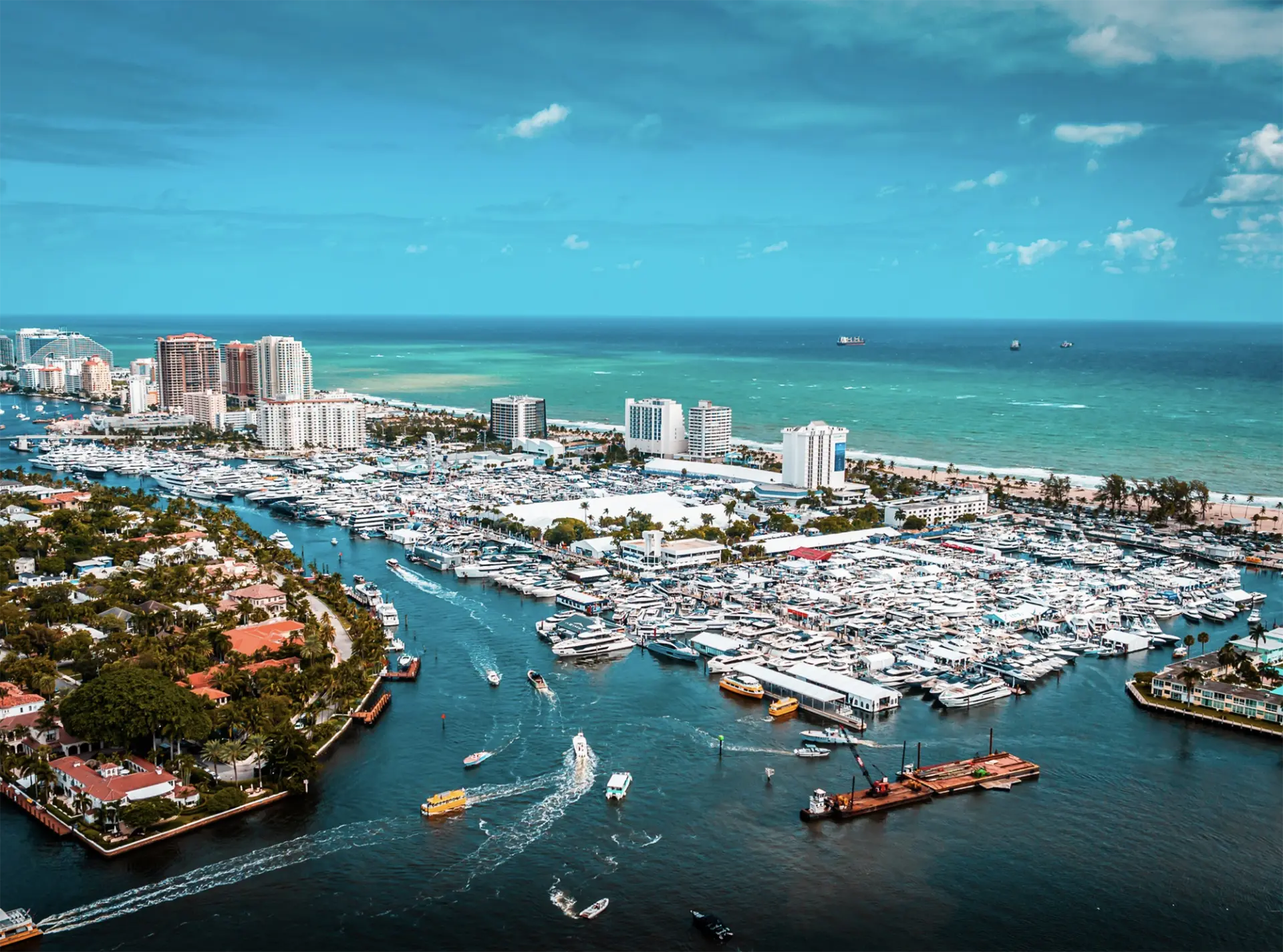
Fort Lauderdale is the Yachting Capital of the World, and FLIBS is the largest in-water boat show on earth: nearly 90 acres, three million square feet of exhibit space, seven venues, and exhibitors that have represented 52 countries. The Marine Industries Association of South Florida puts the show's annual economic impact at an estimated $1.79 billion, supporting more than 100,000 jobs regionally.
The show itself is only the anchor. Fall is when northern boats come out of the water and northern owners start shopping south. Snowbird season concentrates qualified, in-person, ready-to-inspect buyers in South Florida from late October straight through spring, and the calendar feeds directly from FLIBS into the winter season and the spring shows in Miami, Palm Beach and Stuart. Boat show season is a cluster, not a single weekend. A listing that goes live now is in front of buyers for the whole run.
What is actually happening in the 2026 brokerage market?
There are fewer buyers than there were three years ago, and the ones still transacting are spending more and scrutinizing harder.
Northrop & Johnson's Deep Data Department gives us access to proprietary transaction data and market stats. In Q2 2026, pre-owned yacht sales fell 8% year-over-year to 326 transactions, while aggregate sales value rose 15% to $3.51 billion. Motoryacht sales value was up 18% year-over-year to $3.44 billion.
Read those two numbers together: volume down, value up. The buyer pool is thinner and more selective, but the buyers who are active are committing at scale — and they are willing to walk away from a boat that is poorly prepared or priced on optimism.
Two more data points worth knowing. Per IYC market analysis, the U.S. accounted for roughly 32% of global yacht transactions in H1 2026, up from 28% the year prior, and South Florida drives an outsized share of that. Across the broader used-boat market, pre-owned boats now account for roughly 80% of total annual unit sales.
Buyer behavior has changed with it. In 2026 buyers arrive with the research already done. They ask for engine hours, service records and diagnostics before they talk numbers. Price reductions and real negotiation are back in the process. That is not a bad market — it is a normal one — but it punishes a listing that goes up with phone photos and a wishful asking price.
How late is too late to list before FLIBS?
Practically speaking, if the listing is not live by early October it will not be fully marketed when the show opens. From early September, October 28 is about seven weeks out — which is roughly what a proper launch takes.
A realistic seven-week runway
- Weeks 1–2: Valuation and pricing analysis against sold comps, listing agreement, gathering maintenance records, survey history and equipment lists.
- Weeks 3–4: Detail and systems check, then professional photography and drone video on a good-weather day — with a weather day in reserve.
- Weeks 5–6: Listing goes live and syndicates across the MLS and brokerage networks; direct outreach to my buyer network and to brokers with active matching clients.
- Week 7: Show week. Inquiries, showings and sea trials with buyers who are already in town.
| Listed in September | Listed the week of the show | |
|---|---|---|
| Photography and video | Professional shoot, weather day available, drone and interior sets complete | Whatever can be shot immediately, if anything |
| Market exposure before the show | Weeks of MLS and network visibility; buyers plan around it | Effectively none |
| Pricing analysis | Built against current sold comps before the listing goes live | Set under time pressure |
| Buyer inquiries during show week | Arrive from buyers who already saw the boat online | Depend on chance discovery |
| Negotiating position | Prepared boat, documented history, defensible number | Reacting to the first offer that comes |
None of this means a late listing is wasted. It means a late listing is really a winter-season listing — which is still a good season, just not the one you were aiming at.
Start with a valuation and you will at least know which timeline you are on.
What does it actually take to get a boat listed and sold?
More than most owners expect, which is the honest reason to use a broker rather than a persuasive one.
- Valuation and pricing. Not asking prices on comparable listings — actual sold comps, adjusted for hours, electronics, generator, warranty and condition. This is where N&J's access to proprietary transaction data earns its keep.
- Preparation. Detail, systems check, small deferred items handled before a surveyor finds them. Buyers price risk generously in their own favor.
- Media production. Professional stills, drone, walkthrough video, a full equipment list and a written description that answers questions instead of raising them.
- Syndication. MLS listing, brokerage network distribution, the N&J global platform, and direct outreach to brokers with matching buyers.
- Showings and sea trials. Coordinating captains, dockage, fuel, and a boat that presents well every single time someone steps aboard.
- Survey and negotiation. Managing the survey findings conversation, which is where most deals actually get decided.
- Closing and documentation. Escrow, title and documentation, liens, registration and delivery.
Some owners genuinely can run that themselves. Most look at the list and realize they'd be doing it in the margins of a full-time job, during the seven weeks that matter most.
Why list with Elvis Sipe?
I'm a Yacht Sales Broker with Northrop & Johnson, a global luxury yacht brokerage founded in 1949 with offices across the Americas, Europe, Asia and Australia. I list boats globally — South Florida and the Caribbean are my bread and butter, but a listing with N&J reaches buyers worldwide.

- I work out of the Fort Lauderdale and Palm Beach offices, in the market where the buyers are during the season they're here.
- If your boat is far from me — Europe, for example — I team up with one of my N&J colleagues in the local office so your listing gets the same boots-on-the-ground attention it would get in South Florida.
- Pricing on my listings is built on N&J's Deep Data Department transaction data, not a broker's gut feel.
- Product knowledge across outboards, cruisers, motoryachts and sportfish, built at HMY Yacht Sales before moving to N&J. A 38-foot center console and a 90-foot motoryacht are both familiar ground.
- 60+ transactions closed to date, over 2.5 years in the industry.
- Born and raised in South Florida. I know the yards, the captains, the surveyors and the marinas — and which ones pick up the phone.
- My family background is South Florida hospitality and events, which is why selling your boat is a project I manage end to end rather than a listing I post and wait on.
- Regular presence at FLIBS, the Palm Beach International Boat Show, the Miami International Boat Show and Stuart.
You can see current listings and the charter fleet, or read more about my background.
One note on timing that comes up every fall: some buyers are motivated by year-end purchase and depreciation planning, which can add urgency in Q4. How that applies to any individual deal is a question for your own tax advisor, not your broker.
Frequently asked questions
- How long does it take to sell a boat in Florida?
- It varies widely by size, condition, price and season, and no honest broker will promise a date. What is predictable is the front end: a properly prepared listing takes several weeks to photograph, document, price against sold comps and syndicate. Boats that arrive on the market fully prepared and priced against real transaction data generally see meaningful buyer activity sooner than those that don't.
- Does my boat need to be in the show to sell during FLIBS?
- No. Most brokerage boats sold during show season are never in the show. FLIBS brings tens of thousands of qualified buyers into South Florida for a week, and many of them spend part of that trip seeing boats at nearby marinas and yards. What matters is that your listing is live, well documented and easy to find before they book the trip.
- Should I sell now or wait until spring?
- Fall listings get in front of the FLIBS crowd and then carry through the entire winter season and into the spring shows, which is the longest continuous run of qualified buyer traffic in the year. Waiting until spring means competing at the tail end of that cycle. If your boat is ready, earlier is generally the stronger position.
- What documents should I gather before listing my boat?
- Maintenance and service records, engine and generator hours, prior survey reports, title and documentation paperwork, warranty transfer information, the original equipment and options list, and any recent refit or repower invoices. Buyers in 2026 ask for these before negotiating, and having them ready removes the biggest source of delay and doubt.
- How is the asking price determined?
- By analyzing recent sold comparables — not other asking prices — and adjusting for hours, electronics, condition, equipment and warranty. At Northrop & Johnson that analysis draws on the Deep Data Department's proprietary transaction data. The goal is a number you can defend in front of a buyer surveyor and broker.
- Does my boat need to be in Fort Lauderdale to list with you?
- No. I list boats globally. South Florida and the Caribbean are my bread and butter, and I work out of our Fort Lauderdale and Palm Beach offices, but Northrop & Johnson has offices across the Americas, Europe, Asia and Australia. If a boat is far from me — Europe, for example — I team up with one of my N&J colleagues in the local office so your listing gets the same boots-on-the-ground attention it would get here.